
This blog post was human-written by me, Tyler Tafelsky. All of the graphics were generated with Claude Sonnet 4.6.
These days, it seems the entire SEO community is pivoting toward answer engine optimization (AEO), a new era of search marketing that targets being cited and visible on AI platforms.
As more people turn to tools like ChatGPT, Perplexity, and Copilot to find answers, Google’s market share is declining. Even Google has adapted by placing its coveted AI Overviews at the top of the search results, along with its Gemini-powered, conversationally oriented “AI Mode.”
While there’s still a long way to go before AI displaces Google, the trends are hard to ignore. Unfortunately for SEOs, website owners, and businesses at large, the common denominator is that organic traffic is lower than it used to be because questions are being answered without users needing to visit a website.
Despite this, AEO offers hope that SEO remains relevant; only user behavior and mechanisms are changing.
Definition of Answer Engine Optimization at a Glance
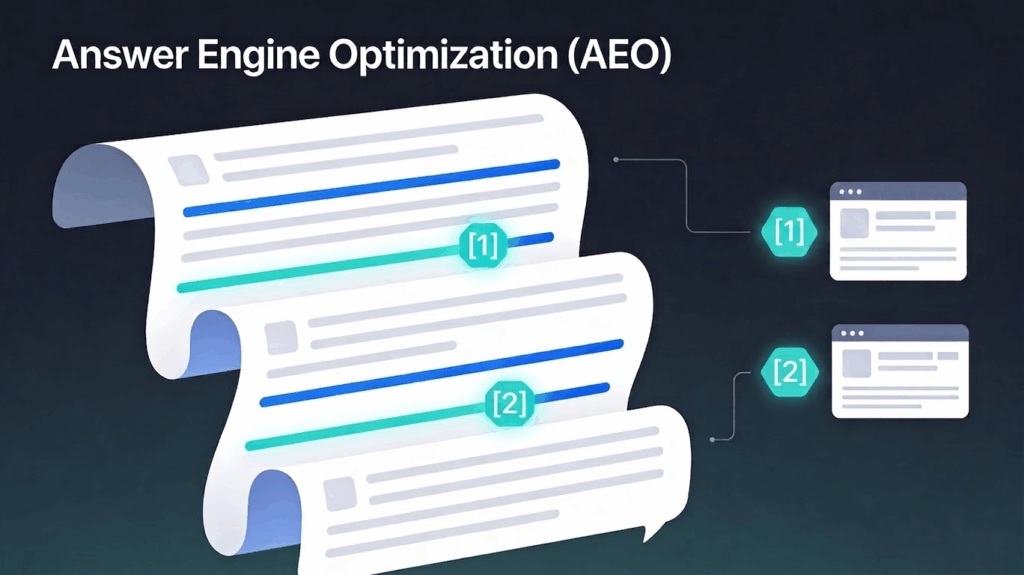
Answer engine optimization is the practice of structuring and optimizing content so AI systems can extract and deliver it as the direct answer to a user’s question or prompt. The goal isn’t to rank in the traditional SEO sense. It’s to be the answer.
ChatGPT, Perplexity, Google AI Overviews, and voice assistants all function as answer engines. They synthesize information from across the web and generate responses without requiring the user to click through to a website.
Multiple studies and in-depth analyses of search behavior found that more than half of all searches now end directly on the results page. This activity is characterized as “zero-click” searches, meaning organic traffic erodes before a user ever reaches your site. According to Rand Fishkin of SparkToro, “Zero-click searches are defined as those that end without clicking on any of the results presented.”
Getting your content cited, whether in AI Overviews or in the generative response from ChatGPT, is the next-best thing to an actual click. And AEO focuses on the answer layer of this process. It’s about positioning your content to be selected, cited, and trusted by AI models as the most credible source for a given question.
The practices behind answer engine optimization span how you structure page content and deploy schema markup, as well as the entity and authority signals that help AI systems evaluate your relevance and reliability.
What Factors Influence AEO and Getting Cited in AI Search?

The large language models (LLMs) that power AI use highly sophisticated Retrieval-Augmented Generation (RAG) pipelines to evaluate content through multiple layers of signals before determining what to surface and cite in response to a user’s prompt. Understanding the factors that drive this process is foundational to building an effective AEO strategy.
To get a firm grasp of what drives AEO, below is an exhaustive breakdown of the primary factors that influence whether and how your content gets cited in AI-generated answers.
Content Structure and Answer Clarity
AI platforms parse content at the passage level, not the page level. Content that leads with a direct, specific answer before expanding into supporting detail is far more likely to survive the chunking and retrieval process than pages that bury the answer in lengthy introductions.
E-E-A-T Signals
As with SEO, Experience, Expertise, Authoritativeness, and Trustworthiness are major factors that AI systems consider when evaluating the credibility of sources. These signals are reflected in attributes like your author credentials, the depth of your content, the quality of your sourcing, and how your site is perceived across the web.
Referring Domains and Backlink Authority
One of the most compelling factors that coincides with SEO’s ranking factors is the backlink profile of a site. More specifically, a large-scale analysis of 129,000 domains found that referring domains are the single strongest predictor of AI citations. Sites with higher domain authority and diverse backlink profiles are significantly more likely to get pulled into LLM-generated responses than those with thin link profiles.
Content Freshness and Recency
Answer engines show a measurable preference for current, up-to-date content, especially in fast-moving verticals. One study found that 95% of ChatGPT citations come from content published in the last 10 months. Similarly, just over 76% of the most-cited pages were updated in the last 30 days. In turn, regularly revisiting and updating high-performing pages to reflect new data, terminology, and developments gives AI platforms the notion that your content is well-maintained and reliable.
Structured Data and Schema Markup
Schema aids AI systems in appropriately classifying and interpreting your content without having to infer meaning from cluttered HTML. Schema types like FAQPage, Organization, Article, and HowTo are particularly valuable for helping LLMs understand the context and structure of what you’ve published. “Content with proper schema markup has a 2.5x higher chance of appearing in AI-generated answers,” reports Matt Pru of Stackmatix. “Sites with complete Tier 1 schema see up to 40% more AI Overview appearances,” he adds.
Authoritative External Citations Within Your Content
One of the most widely cited research papers on Generative Engine Optimization (GEO), which is a related subset of AEO, found that adding credible statistics and citable sources to your content can increase its visibility in AI-generated responses by up to 40%. The logic is straightforward; AI systems trust content that demonstrates it has done the research.
Entity Recognition and Brand Consistency
When an AI model associates a particular set of words or names during training, it develops a deeper understanding of what those words represent. Similarly, when a company’s brand name, product(s), and areas of expertise are consistently associated with one another and repeatedly mentioned across reputable sources, a model will develop a clearer internal understanding of who they are, what they do, and which topics they are authority figures on. Consistency in entity recognition across your website, social profiles, and third-party references also helps solidify these concepts.
Semantic Relevance
Unlike SEO, AI search doesn’t reward keyword density. Vector embeddings allow LLMs to match content based on conceptual meaning, so a page discussing “B2B pricing strategies” can surface for a query about “how to structure volume discounts” if the semantic relationship is strong. Writing with topical depth and conceptual precision matters far more than keyword placement.
Question-based and Conversational Content Formats
AI search is primarily driven by conversational or question-oriented prompts. As such, content written in formats such as FAQs, how-to guides, and scenario-driven explanations will typically be processed similarly to how LLMs process the same types of user queries.
Brand Mention Volume Across the Web
Similar to backlinks, other forms of off-site signals are a real catalyst for AEO. Contextual mentions in authoritative publications, industry directories, and niche media signal to AI models that your brand has genuine real-world relevance. This is a meaningful differentiator from traditional SEO, where backlinks alone often define off-site authority.
How AEO Differs from SEO

For years, SEO has rewarded volume, broad keyword coverage, high domain authority, and lots of pages targeting many queries. AEO operates on an entirely different set of standards. The underlying focus is precision and providing users with the single most credible and direct answer to a specific question.
Content structure is where the biggest differences show up in practice. Conventional SEO content favors long-form depth and topic clusters, while AEO content demands short answers, Q&A blocks, and scannable formats that AI engines can extract and cite. In practical terms, AI engines scan for a clear, concise answer in the first few sentences of a section, and content that buries the lead gets passed over.
Various sources of research suggest placing a direct answer (40-60 words) immediately after each heading to significantly increase your citation rate in AI results. Often termed “BLUF” (Bottom Line Up Front), positioning immediate answers under each major heading creates “atomic” content that is highly extractable for AI search.
Expertise signals have a greater impact on AEO than on SEO. Answer engines take into consideration content credibility based on accuracy, citations, author expertise, and consistency with other authoritative sources across the web. Conversely, surface-level overviews rarely get cited because AI models are trained to favor content that demonstrates genuine depth and a clear point of view.
The tradeoff worth grasping is that AEO tends to produce fewer clicks but higher-quality engagement when users do click. A SEMrush study found that visitors who find you through AI-powered discovery convert at 4.4x the rate of traditional organic search visitors. The intent signals are stronger because those users have already received a curated answer and chose to dig deeper.
Voice search and, consequently, conversational framing also play a larger role. Siri, Google Assistant, and Alexa are essentially AI-infused voice search tools that have become household names as answer engines. Because AI search is generally based more on natural-language questions, providing content written in a direct, human tone tends to perform better than content structured around fragmented keyword phrases.
Need Help With AEO?
Having been in the SEO profession since 2009, I’ve seen the dramatic evolution of search marketing, from the black hat days when keyword stuffing worked to Google’s helpful content update that shook up the search results. Over the last few years, I’ve been embracing AI and pivoting my craft as a content strategist to mastering the fundamentals of answer engine optimization and helping clients leverage AEO to maximize their visibility.
If you need help with AEO or have questions about this practice, don’t hesitate to reach out to me. You can also learn more about my services in AI search optimization.
You might also like: